In lay terms, this means that one of my very good dear
wonderful friends is moving into her very first on-her-own apartment.
I wish her all the best of moving vibes, from good weather to
good-humored and prompt moving helpers to good pizza and good sleep.
(Which is less that she has earned as she has helped me move more
than is reasonable. Usually in heels. I am thinking specifically of
the buffet.)*
But that’s not really the point.
I kind of don’t mind moving, at least
I didn’t. The packing and cleaning and sorting and dusting and
sneezing and throwing out of things worked as a kind of identity
therapy. I got to touch all of the things that made up the world that
fit into the set of |Me|**. Journals, letters, books, shrines,
ceramics, mementos, missing laundry – all of it active and real
elements of an entirely self-created self-definition.
Conversations at work have included an
ongoing debate with my friend about the spectrum of introversion and
how to apply it. He spoke a thing that I think I’ve been missing
about the world for a really long time. The conversation went
something like this: Me – You don’t get to define me. Him – We
are all defined by other people! Me – stunned silence
*eyebrow up*
Well, but I’ve always been that way,
right: “I’ll be my own self!” foot stomp “No one else
is the boss of me!” “You do not get to define me!” (I have said
that one a lot)
It smacks so cheerfully of
childishness, doesn’t it? How easy to dismiss are claims that do
not fit the dictionary definition.
Because I have moved a lot, and I know
the difference between |Me| and ‘hippie’, ‘free-thinker’,
‘snob’, ‘sweetheart’, ‘original’; the list is long and I
am not alone in having one.
(I do not credit this attitude problem
with tens of moves, but the inventory is part of living in this space
around me, and that is directly connected to moving.)
And yet…
We learn how to behave based on outside
expectations. We frequently only see our actions as they are
reflected or refracted in other peoples’ lives. Our class system
maintains itself with rigidly defined behavioral policies and
expectations. The social constructs we are taught to accept without
questions are predicated on outside, not self-control, as well as
predestination not self-determination.
Every day brings more support to the
dangers of stereotyping: externally imposed definitions –
diminishing by definition. Every day there is evidence drawn in blood
that it is not safe to fail at accepting external definitions. And
every single day individuals still make the decision to escape the
social constructs, the naysayers be damned.
So, I guess what I really wish for my
Princess is the time to see what her life looks like on the inside.
What the last years have made, hidden and lost. Find the absolute
value of yourself in the silence and chaos of boxes, bags and Moving
Day.
This year, I’ll settle for deep
cleaning.
*Apparently the move has already
happened, but whatever. The sentiment is the same.
** |Me| denotes the absolute value of
whatever is listed between the bars, in this case: Me. Math is cool.
Friends, I find me in a deeply
dangerous situation.
The wind moves. The keyboard is warm
and welcomes use. A blank page: unused file space. What delicious
adventure.
The world is filled with broken tree
limbs, gardens filled with clay, air still as algae, the body made of
sweat at the very edge of a heavy terrible headache. Summer becomes.
Sleep may be a dream tonight, waiting
for the cool to land.
I crave books of walks, long
conversations, politics, morality, food – ah, food – dusty travel
and bitter endings.
It has been more than a month since I
read the review copy of The Art of Joy and still I cannot face
fiction that is uncrowned with the name ‘canon’ – how I
relished it!
It would be a lie to say that to be
surrounded by Beauty makes noticing that which is beautiful difficult
to see. It would be more correct to say that there are different ways
to see Beauty, because it takes every different form. Sapienza’s
great work shocks, titillates and provokes as it draws you in almost
tenderly without care or gentle caress. This novel, much like its
protagonist, does not need to care for you, but does need you. I do
not remember the last time that I jumped when addressed by the
author. (I am sure that it has happened before. It is forever a shock
to be seen instead of safely invisible, regardless of the
circumstances.) When Modesta calls out the fourth wall, it is
destroyed. Such is her power and the strength of her narrative.
The constantly shifting routines of
work and life have begun to be familiar, and now there is time for
getting into trouble again. Trouble in my world is in story, fairy
tales and odd little sestinas. The USPS and I occasionally are on
again.
This evening my fingers found
themselves in motion on these keys, with nothing else to add but what
they themselves created.
I am out of practice, but the habit and
muscle memory are well established. I do not miss the troublesome
rush of creation or the conflicted afterglow: exhausted exhilarated
stiff with stillness and incapable of the moment, whatever moment it
is. I am terrible at drugs, even the ones that are the same as just
being me: learning, connecting and occasionally creating.
Writing again has got me thinking. And
thinking gets me writing. Well, thinking about traveling in cars gets
me thinking more and then there are words but most of them come out
kind of like bursts of memory because what I think about are the
images that I keep on quick-recall not the ones that I’ve got
attached to the pictures from that one trip, or a different trip; the
one that got no photographic evidence at all – the ones that are
clearest in my world because there is no other record of them than
the words that frame the memory of the image that marks a place on
the road.
Not some figurative road, nothing about
growth or becoming. An actual road.
The road in the Ozarks coming out
of a storm so pitch black and pouring rain it was impossible to
think and impossible to do anything but that with my father driving
the Jeep and the music silent and then the stillness of no more rain
and then the impossible glow in the distance and the music rising
and the sunset fiery as the first dawn and yes, yes I do Hear The People Sing.
A field in the middle of the Black
Hills. A few weeks before something extraordinary and magical in a
group of people converging safely away from all of us. My father and
I and the dogs and the Jeep and another sunset, this one quiet and
impossible, the music only evening insects and we cracked cheap
bears on the roof and watched the sky and the dogs racing circles in
the unfamiliar world.
My mother and I return to our
homes after a holiday spent all together and along the highway a
huge bird of scavenging will not take flight from his road kill and
we cannot swerve, he is that large and the road is that small and he
finally takes off and I swear his talons scrape the outside of the
windshield and I cannot even laugh to ease the tension it is so
beautiful and so close to something so different.
A poem in a car, on the player in
the dash. A woman’s voice, a man’s voice and there is power and
there is grief and it is thrumming and I am lifted and the words end
and the silence of their ending begins to enfold me and “The End!”
says my friend and it is right and it is awful and I laugh and never
forget to remind her that her timing is more odd than mine.
Twists and turns in the backroads,
not the highways, between my house and hers, her mother not wanting
any of her girls on the highway for safety reasons so we drove
through brick-filled neighborhoods and knew all of the potholes and
the best Taco Bells and here it was we found the difference between
temporary acquaintances and friendships in shared breakfasts and
rain-soaked road trips and even now I hear her voice and it is next
to me in the car and we are heading home.
And the paths that lead through
burial grounds in towns across Nebraska and Iowa and Missouri, and
the names are of my family and mine will not join them, not here.
And the ghosts of my family do not bother each other in these
places; they stay home, in the kitchens, at the tables, on the other
end of unanswered phone calls, impossible conversations. Perhaps
they are why the car trips: we bring home the stories they cannot.
And the road that I did not drive.
The one that took us by the corner down from the one that used to be
mine. And I was terrified at it and drunk and you were Telling Me
Something and all I could think was how far away it seems, and how
far away it is and I could not talk about anything real and it is
only now that I can measure the distance and I wonder what that
means. And I wonder what perspective the next road will throw on the
one that I travel now. Especially since now I have a bike. Bike!
Winter dreams made their way to me last night. Darkness and boxes filled with stories and cards and the cool warmth of some unknown lover's skin and it took me a while to remember.
These are dreams that have slept for a couple of years. Perhaps they were waiting; perhaps there was no room for them; perhaps I simply did not remember and they left no mark on a moving soul.
The season changes soon, and my dreams reach out to me to give comfort that the sun will fade and I will know again the feel of warm air against cold and find something like a blanket in the change and the dreams will be dark and terrifying and filled with blood and water and boats and impossible feats of violence and embrace.
In my winter dreams I do not need to fly. In my winter dreams the world holds me at its own distance. Warm long days lift my feet in sleep and I do not need the wings I learned to grow. The green smells of birth in spring hold me hovering between rooms. The spice and wood and burning of winter open something that needs only stars and wool and honey to feed it through long nights of worlds unremembered.
The rhythms of my heart will change. I feel again this strange and terrible peace. The smell of me begins to alter, and something new makes its way into the world. This is an entirely different sort of bear, living here in the warmth with a short dark breath between the heat and the weight of water.
Perhaps the dreams return because they are remembered. Perhaps I am less out of control of their presence than all this would make it sound.
The days are shorter without any assistance from me.
I’ve not been to work for three days.
I’ve not stepped on public transport for that long, either,
although I did buy my March bus pass, but that’s not even close to
being the same thing. My laundry is done, my fridge is cleaned out,
although it is not clean and there’s been some sweeping around the
place that pleases me.
It occurred to me, when this vast open
space of workless days all in a row presented themselves, that I
would have no idea what to do with the time. Ha. Ha!
I read a lot. So much that I am not in
a place where I can read anymore right now, or listen to music or
lectures or even feed myself, because I’m Just That Full.
Homer has been with me this entire
time.
The entire first chapter of ExtraVirginity features Odysseus and olive oil and the questions
surrounding what that means to people in our version of the here and
now. At the end of the chapter, someone made scented oil with roses:
it smells of the Mediterranean.
Jerusalem was bound to bring the bard
to mind with its layers of tragedies and homecomings. Leaders
deposed, peoples massacred, livelihoods destroyed under the orders of
army leaders not even attached to the city’s people or land; these
echo.
I’d sort of hoped that Blood, Bones & Butter would lead me away from the violence and harshness of
olive oil and sea travel and a world filled with instability and
fragility and I was wrong. It left me full and vulnerable and the
mere mention of oil from Puglia cast a net over this incongruous
reading list and day-to-day living that I can barely begin to
imagine.
Even the mystery that I read did not
let me be in peace; ideas of responsibility for actions over time and
human behavior and the traps of class and how education does not
always allow people to get out of them finding their way through the
muck of London sewers and into my nice little world view.
What is here is not what I wanted to
say, and that’s alright. My feelings are definable, what they
relate to is not yet real in words. I remember The Loss Library and
its central story and the shelves of books that would have been
written but for confidence or silence or carefulness and I must
re-think my audience and consider the shape of my walls and perhaps
the words that overflow will land on them.
For someone who is not a member of any
Abrahamic religion (a book person who is not one of any of the People
of the Book, go figure), I take this pretty seriously. Actually, I
take it pretty seriously even for one of the faithful. There is no
dogma between me and my reading of similar experiences in the lives
of four of the most profound religious leaders of human history.
1) Moses went to the mountain to speak
with God. He stayed there for a really long time. 40 days. He came
down with the 10 Commandments and a life path that was not a
question, or temporary. He knew what he was about, and God needed no
more burning bushes to get him to listen.
2) Jesus went into the desert for 40
days. There, we read that he was faced by the Devil who offered him
every enticement he could think of to move this leader of men from
his path. The Devil failed. Jesus returned to the world of the
everyday and did not, we read, veer from His life path, even though
it led Him to death.
3) Gautama found himself seated under a
Bo tree for 40 days, contemplating the nature of his purpose and
path. Demons came and attacked him and as their arrows flew through
the air, they were turned to flowers and fell harmlessly at the feet
of the Buddha. When he opened his eyes and turned his gaze outward
once again, he lived his life with clarity and purpose and did not
veer from his life path.
4) Mohammed went into the desert. He
stayed there for 40 days. Allah spoke. He listened. He understood. He
returned from the dessert and gathered people together and spoke to
them of the teachings of Allah. He became The Prophet and lived that
path without question.
Rama was banished to the forest for 14
years.
That seems a bit much, if you ask me.
But, I am young and have no sense of the meaning of time, and I do
not always understand what the world means to mean.
Two years ago, I began to work to
change my life. It worked. It is time to finish that work and learn
to see that 14 years in the forest is only a short time.
So. We focus. Although: Got no desert
or big beautiful tree or local mountain. Also: Got a job that I feel
is pretty vital to life.
So. We focus in a different way: give
up the distractions of coffee, booze, eating out (with specific
social exceptions), big grocery store shopping, late rising, no yoga
and no writing. Also, I’m not in the mood to be as cranky as I
usually am when I start getting all healthy and feeling good. So, I’m
going to give that up as well.
Which I don't start until the 14th, so am not jinxing with actual posts and info and whatnot.
There's a ton that I want to write about and hone and make concise and keep wandery and surreal and filled with links and staggered with images, but that will have to wait.
I've become quite fond of this concept of late. Mostly because I've got things to do and there's just not enough space to make time at every moment for everything that I'd like to get done, but there is definitely time for all of it.
Working again, so fun with scheduling and availability and reading and watching the television and having lunch - did I mention lunch? Lunch is of good.
That's all really - I'll be around again, but first I'm going to be healthy and rested and interested.
The last part of a passage I previously quoted reads thus:
“It’s tempting to say that his [Panizzi’s] discovery of intertextuality among
even the most mundane books forebodes the rise of the interconnected world of
the digital age; it’s probably more accurate, however, to note that, from the
vantage point of the wire world, Panizzi’s catalog looks like the beginnings of
the Internet.”¹
I immediately thought of Douglas Adams whose piece called
“Build It and We Will Come” was published in The Independent on Sunday in November of 1999. The writing is
included in a posthumously published collection of Adams’s
writings called, delightfully, The Salmon
of Doubt². It is also available as an audio book, which is how I first
experienced it, and makes for wonderful and enlightening moments. The breadth
of the man’s interests and writings astonished me and was also incredibly
freeing, as was the recognition of the difficulties of writing to deadline.
Why this piece in particular? Because of the thesis
statement buried deep in the middle of the thing: “The computer is actually a
modelling device. (92)”²
Because the person who wrote it is Douglas Adams, and
because I agree with him firmly based on the evidence given in the
aforementioned essay as well as independent ponderings after the fact, I’m not
going to try to convince you of the truth of the matter. I’m going to treat it
as fact.
Thinking of the catalog of Panizzi as the monster of
bibliographical information that it must be (with equally contorted card
catalogs that threatened to, and eventually did take over many library lobbies
and reading areas, and the sort of relief the floors may have felt when
computers with much smaller footprints began to carry the same information):
what exactly is a catalog modelling? I believe it is the brains of The Library.
I would say that the catalog is modelling the actions of Librarians, but they
are (in Truth if not in practice) specialized beings whereas catalogs are
created for the generalist user/reader/patron. Online catalogs are incredibly
useful entities for organizing, tracking and adding to or removing information
from entries into the catalog. They have the potential to interact with other,
already established catalogs, create MARC records with little strain and also
can be programmed to make bar codes and spine labels.
They can do everything that a team of librarians can do, and
they can do it more quickly and with less overt physical effort on the part of
those librarians. They do not replace human ingenuity or interaction with
materials, and they do have to be made to be flexible. But the basic idea of an
online or digitally maintained catalog is that when a person, a human, looks
for a book, that person goes to a provided computer terminal or available
website, enters the information that is at hand, and is given the coordinates
to find that item within their current context. Lists of books that don’t get
checked out, lists of periodical titles that the library holds subscriptions
for, items that are on order, damaged, in transit, etc. are generated as part
of the library’s functioning.
I know a woman who works at A Novel Idea in Lincoln, Nebraska
whose co-workers describe her biblio-recall abilities as watching her flip
through her mental Rolo-Dex. I’m sure that the information that she stores on
those cards appears in different places as the keywords or characters or
impressions or genres are the unique search terms in different situations. It
takes time to build the kind of depth and specificity into such a mental search
engine as she has, but I have felt it begin and have encouraged it to take root
on my own, and while mine is more of a commonplace book or recreation room
strung with yarn and connecting images, and will never rival the power of what
an online catalog can accomplish, still, it is confirmation that our brains can
and do surpass our wildest expectations of them.
The library catalog has the potential to accomplish
something no less daunting than magic. It can help a reader find something he
or she was sure they’d never be able to identify. It cannot always leave traces
of how to find the treasure someone seeks, but it can, through subject
headings, authors, titles, series titles, keywords and the like, show the
reader something like the path that was taken to get to the treasure the first
time.
In order to accomplish such formidable tasks, minute and
thorough items of information have to be identified and entered into the
knowledge base of the catalog. It must be told when and how an item came to be
in the library. It must be told how an item relates to another item. Humans
must make educated guesses about the use of an item and include what
information will allow that item to be used and useful. Other humans may be
given the opportunity to add reviews and search terms, to suggest connections
that the catalogers may not have known existed. Involving the patrons in the
development of the library catalog is one of the brilliant strokes of catalog
development. It has need for mediation, but it is a powerful way to engage
library patrons with library materials.
The catalog is a model of the relationships built between
libraries and their communities. It is in deciphering those relationships that
we learn about the design of the model, and what meaning the library is seen to
have in the community.
¹
Battles,
Matthew. Library: An Unquiet History.
W.W. Norton & Company, New
York,
2003. 214 pages +notes & index.
²Adams,
Douglas. The Salmon
of Doubt, Harmony Books, New
York,
2002. Paul Guzzardi, ed. 299 pp.
³Mentré,
Mireille.
Illuminated Manuscripts of
Medieval Spain,
Thames and Hudson, Inc, London, 1996.
Jenifer Wakelyn, trans. 304 pp.
Before I end this, I have to put my nomination forward for
canonizing Douglas Adams (who was, I know, an atheist; have a sense of humor).
I thought of that particular essay as I was typing up the other post. At the
library, I went looking for Homer in order to get details and ideas in mind for
what I plan to write during November (NaNoWriMo!), and found The Salmon of Doubt instead. When I’d
gotten home, fed the (starving!!!) cats, and unloaded my library haul (Illuminated Manuscripts of Medieval Spain³,
anyone? Oh, yeah), I opened the book right to the essay I wanted, even to the
page and almost the line. You can’t respect the man without at least nodding at
his beliefs, so I can’t quite see naming him a Deity, but at least a halo of
connectivity on portraits? If someone gets a chance, ask Stephen Fry, will
you? He’d know what to do.
Attempting to read up on Agapanthus
becomes an increasingly interesting adventure. I learn not much that is
terribly surprising, but I am a bit stymied in my limited resources. Right now
I have access to one book in front of me and a few that I’ve requested at the
library. It is in that light that I must turn back to what is in front of me:
the paintings and a handful of books and articles, and mine them instead of the
shelves of possibilities that I know exist.
As a relative amateur when it comes to art criticism, and a
virtual expert on talking about whatever comes to mind, this series of blogs
has become something of a quest with me. There is only so much that can be seen
when looking at 3 paintings, no matter how large. There is infinitely more that
can be said about them, or learned about them, or discovered underneath them.
But without ever seeing them, without ever looking at what is in front of your
nose, none of the rest of it is more than mere decoration.
Simon Kelly, in the wording that accompanies exhibit, talks about
the effect that the lack of horizon line has on the painting itself and on the
viewer. It is true – these are works that exist almost entirely outside of the
standard geography of living. There is no bridge, there are no reflections; you
do not know what time of day it is; who is around, if anyone or if there are
any deeper meanings to the shapes and shifting swaths of color in front of you.
I hate to be too pithy, but all of this almost forces the viewer to be
reflected in the paint: we see ourselves in the surface. At yet, the experience
is not disorienting. It is stunning, or at least it can be, but not upsetting,
not to us who are so accustomed to such vast expanses of undefined space.
In Monet at Normandy,
the publication that accompanied an exhibit by that name in 2006 & 2007, it
is possible to follow Monet’s use of perspective and point of view from the
1860’s through to the Cleveland
panel of Agapanthus, and it is a remarkable development. Discussing the
painting A Seascape, Shipping by
Moonlight from 1866, the authors address his use of space. “Monet plays
with the viewer’s sense of equilibrium by omitting the jetty itself from the
field of vision; only the stabilizing line of the horizon as it intersects with
the strictly vertical rigging of the boats on the left counters the rolling
pitch of the boat in the foreground.(56)” He is not creating here a sense of
floating in the absence of the horizon, he is deliberating unsettling his
viewers with very little that is stable and much that rolls and is unstill.
In other places, the experiments with perspective seem to be
excuses to provide space for the sea or an expanse of beach or sky instead. As
can be seen in his paintings of commercial ships in the port at Le Havre or on the Seine at Rouen, he is not shy of detail or
specificity. In fact there is the sense that he is communicating something
extremely specific, even in the Wisteria
diptych that is still incomprehensible to me. (I have to admit here that I’m
falling hopelessly in love with his paintings of the Seine at Rouen – the ships are functional and ethereal
at the same time, and the skies are filled with a sense of wind and rain and
diffused or too bright sunshine. Exquisite!)
“While the viewer instinctively constructs spatial relationships
based on scale, position, and color, the artists himself seems no longer bound
by such conventions.(168)” And we do, don’t we? Without thinking about it, we
decide that there is a top and a bottom that are usually related to the top and
bottom of the canvas. We plot the position of shapes and colors not just on the
canvas but in relation to each other in the three dimensional space behind the
canvas or in front of the canvas. We address ourselves in relation to the
paintings: where am I standing in this painting?
I wonder how many of us place ourselves where we have so
often seen M. Monet placed: in the garden, under an umbrella, palate on arm,
cigarette smoldering. Or in his studio with the gigantic canvases leaning
against the walls, as much a part of that space as any other. Perhaps more so.
With so many visitors and so much attention given to the work and the garden
while he was still alive, it seems plausible that there is as much of the life
of the artist’s studio in the layered and floating studies of water lilies and
absent agapanthus in these paintings as any representation of nature’s
variability.
As much of an intellectual exercise as these can be, there
is something excitingly simple and human that can be experienced viewing the
triptych. They were part of a larger work that was intended to honor the end of
World War I and the veterans. In that light, the serenity of this series has
more weight than any horizon line could ever hope convey.
I’ve been looking for pieces of contemporary criticism to
give context outside of the artist and outside of the 20th century.
Of course, the source that I’d love to read is in the St. Louis Public Library
catalog. And equally of course, it is a reference book (non-circulating) of the
Central Library (which collection has been moved entirely to a storage facility
while the building is closed for renovation until summer of next year). So, how
does one get a look at such a thing? The adventure continues.
Lemonades,
Heather, Lynn Federle Orr, David Steel. Monet
in Normandy, Rizzoli, New York,
2006. 192 pp.
I’ve begun building a master
list of jobs that I’ve held over the last several years. The list is intended
to aid me as I fill out online and paper applications. It is not short. A
friend of mine told me that she’d read that you only need to include the last
seven years on applications. That’s nine jobs.
Facing the uncomfortable truth that when put next to a
timetable created by societal expectations, if you take out my age, I’m not
doing badly for a person who graduated college 6 years ago. It’s like the 11
years that I spent getting married and divorced just shot a huge hole in my
life path. (I typed ‘whole’ instead of ‘hole’ there at first, and didn’t notice
it right away. (Quick little-Sarah story: When I started taking piano lessons,
Mr. Williams, may he rest in well-played peace, taught me about rests by
drawing them on a chalkboard. He drew a small rectangle under one of the lines
on the staff and said, “When you walk down the street, you have to look out or
you’ll walk into a…” meaning for me to finish the sentence with ‘hole’ as
homophone to ‘whole’ to teach me the name of the long rest. I looked at the
drawing and piped up “Sewer!”) and now I’m happy on the inside.)
Job applications do not lend themselves to creative life
paths. By creative I do not mean artistic, I mean self-defined (which, yes,
given that I view works of art as defined by their active answering of
questions and being evidence of deliberate decisions is not entirely
consistent, but you get the idea). The last 15 months saw me taking jobs in
order to work, not in order to further a goal. The goal was not firmly in mind
until the beginning of 2009 anyway and since then hasn’t altered one whit, nor
has my intention to achieve it, nor my continued research and active
contemplation. But there isn’t really room for that on a job app.
It’s uncomfortable. I don’t particularly care for it. I feel
required to provide spin for my life, not simply to others but to myself as
well. And yet, I lived it. I process it daily. I am in no way unaware of the
effects of my decisions on the directions my life has followed, frequently more
than one at a time. It is not without consequence. And yet, I am in no way
certain that some Life Lesson about marrying intelligently or a self-deprecating
attitude towards my mistakes or not
having anything to show for the
living I’ve done is correct or morally acceptable. It is lived. It is done. I
am here. There is no judgment anymore.
My skillz set is impressive, I tell you.
This is not unrelated to what showed me it was time to
escape the inertial pull of Lincoln.
It, this discomfort and getting past it, is part of learning to be in the
unfamiliar and not quite known or understood place. I realized that I could
have struggled in the same ways with the same set of incrementally lowering
standards and been progressively less able to turn potential into kinetic
anything – or, ask my parents for help and slow down and take the time to do
the crap things like this.
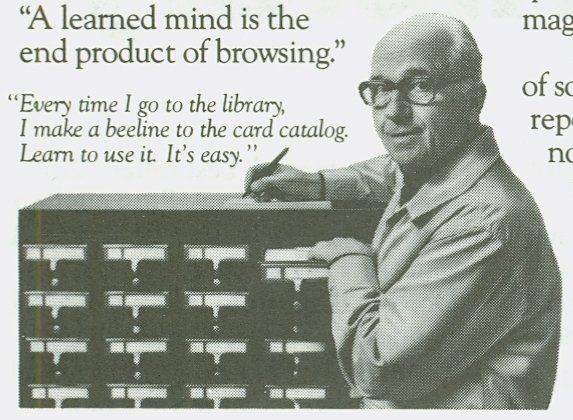
The Library Catalog: that labyrinth of titles,
authors, subjects, keywords, publication information, series titles and perhaps
even major characters that is the map to infinite intellectual treasures. Well,
it is now. When I was younger it was a torment invented by cranky old men and
women who wanted nothing more than an empty room and silent students giving
correct answers. Ah, the gentle nature of youth!
I am still working through Matthew Battles’s book Library: An Unquiet History, and
thoroughly enjoying myself. Today, I read about Antonio Panizzi, the man who
redesigned the library catalog of the BritishMuseum
and in so doing, changed the way patrons and librarians interacted with that
catalog permanently. He was a young attorney who found himself in exile from
his home state of Modena
in Italy
in 1823 after publishing an account of the trials of revolutionaries with whom
he’d associated. He escaped over the Alps, was sentenced to death in absentia
and eventually found himself in England where he tutored in Italian, learned
English and eventually got himself appointed assistant librarian at the British
Museum in 1831 (128-9).
His work “cataloging a collection of impossible complicated
tracts from the English Civil War (129)” marked him as the best person to take
on recreating the catalog from 1810, which in seven volumes with pages and
pages of notes and addenda was becoming unusable. That catalog had been written
as an inventory, in alphabetical order by book title, and Panizzi found that in
many cases information was incomplete and there was no connection drawn between
any of the works.
“Such crucial information as the author’s name, the
publisher, and the date and place of publication might be incomplete,
erroneous, or missing altogether. Panizzi developed a series of rules that
reproduced these relations in the catalog, so that librarians – and crucially,
readers – could trace and follow them. Unwittingly at first, he was helping to
transform the library catalog from an inventory into an instrument of discovery. (130)” (emphasis mine)
In 1837 he was appointed Keeper of the Books and in seven
years published one volume: A. The
amount of time that it took Panizzi to create the catalog inspired a certain
amount of grumbling on the part of some people, namely one Sir Nicholas Harris Nicolas. Battles explains that part of his invective was to do with jealousy
that Panizzi had so much influence in the library, partly there is a concern:
“he is afraid that it (the complexity of the catalog) will make the reader do
more work. (131)” While that reads alright, as Battles goes on, we begin to see
there is something far more familiar than empathy at work.
“Early in the project, Panizzi had chosen to add the
‘pressmark’ of each book to its entry in the catalog. Like a call number on a
modern library book, the gnomic pressmark indicated precisely the place where
the book was to be found among the shelves of the library stacks (or ‘presses,’
as bookshelves were commonly called). (132)” The idea is that the pressmark
indicates a geographic location; it does not refer to a subject or topic as
Dewey call numbers do. If Dewey number 720.977 will find you in front of a book
on Architecture in St. Louis, the number 230 c 9 in Panizzi’s catalog will find you looking at a book in the
press (shelves) numbered 230, shelf c,
position 6 (I’m thinking from the left, but that is a culturally grounded
assumption).
Nicolas took offense at the amount of work a reader had to
do to learn and understand all 91 rules Panizzi developed for his catalog.
However, “Nicolas sensed that Panizzi was trying to produce not only a new kind
of catalog but a new kind of reader as well – one more independent, more
knowledgeable of library systems – and he wished to play no part in the
revolution. (132-3)”
In Panizzi’s view of his catalog it was something that ‘”the
public have the right to expect in such an institution”…”I want the poor
student to have the same means of indulging his learned curiosity,”…”of
following his rational pursuits, of consulting the same authorities, of
fathoming the most intricate inquiry as the richest man in the
kingdom.”(130-1)’ His work was not intended to play the part of something like
a shopping list, it was meant to draw readers into the world of discovery, and
to provide equal opportunity for every reader to be drawn in, not only the rich
and not only the poor. His rules built bridges of connection.
I’ve never seen this catalog. I would love to. I expect that
it would look fairly incomprehensible at first. Then again, I felt that way
about Dewey and also about Reader’s Guides and most bibliographies.
Libraries now seem to be catering to the reader like
Nicolas, who does not want to think too much about deeper questions than “is
this title available and for how long can I have it?” I begin now to see
catalogs grounded in the philosophy that it is not necessary for readers or
librarians to draw from a diversified and intellectually stimulating range of
texts and materials, rather that staying with the range of a single title will
do just fine.
It is a revolutionary idea anymore that challenged and
challenging inquiry is the mark of a well-grounded and developed adult. There
is subversion in seeking out more than one answer to the same question. There
is even more subversion in finding more than one question to go with each
answer. Libraries do not have to be veiled hiding places of incomprehensible
babble. They can be transparent organisms well-traveled and identified.
Catalogs, well designed and maintained (not easy work, either of those), can
begin to provide libraries with transparency, but they do need to be learned
and translated, and that is not comfortable.
Battles,
Matthew. Library: An Unquiet History. W.W. Norton & Company, New York, 2003. 214
pages +notes & index.
The library was filled the other day when I returned my
books. I was the only person with a book in hand. Every person at the reading
tables faced a computer, and almost all of those computers showed the familiar
profile of Facebook.
For all of the focus and silence of reading, there is
something less disconnected from other people about a person reading a book than
about a person working on a computer. It is the same as the difference in
relative realness between a long and intimate email and a short hand written
note received through the mail. Interacting with the physical lends strength to
physical living? Perhaps.
Perhaps it is that there is something innately comforting in
the sight of a person interacting with something that is as tangible as a body.
Or, that there is something discomfiting in the sight of a person interacting
with something that is by definition bodiless.
The street outside is filled with the sound of shouting
people. There are only three of them, but their voices are traveling through my
windows with the force of a home run. There is goading and insulting and every
now and then a conversation in the alley drifts across the others and I am
confused, combining conversations into: “I’m walking in the alley, man!” “Are
you gonna buy this?” “Where’d he go?” “Come out here! I’m on the porch, I can’t
see you!”
It is all very not of me, and all very human, very physical,
very much happening. The streets outside my building are quieter than I think
they ought to be given the number and variety of people who inhabit these
buildings and homes. A woman I spoke with suggested that once inside after
supper, everyone goes to the Internet and just stays there. I don’t know if
that’s true, but it could very well be. The streets are thus emptied of conversations
and giggling and secrets and people walking and I don’t know if anything has
taken their places. From what I hear it is quiet.But like I said, it is really quiet.
I’ve been thinking about the dangers of isolation – about
how you can go crazy always being in one place talking to almost no one else.
Paranoia is easily spread in people who have no experiential proof of an
outside that is not filled with cutthroats and gangsters. The more paranoid
people become, the less likely they are to venture out. And the outside has
room for the violent and disturbed because there is no one to provide the kind
of social pressure that’s needed to keep that behavior out of the realm of
public interaction.
It’s an old social dilemma. What city street has not known
violence? What neighborhood has not feared for its children and elderly? How do
you keep the crime off the streets where it is socially disruptive and lends to
damaged people leading lives outside of a sustainable community?
Pretending that there is a way to end crime is extremely
naïve and unsettling. Humans are asshats and always have been. The best you can
hope for is a strong community ethic that does not have to rely on Community
Contracts or fascist walled neighborhoods and prohibitive rules of behavior
developed from advertisements for socially conscious economically irresponsible
upper middle class families. I may not dig being poor (low-income, baby) but I
have more freedom of movement and less social restrictions on my travel and
activities than I remember having when the world I moved in was less, um,
economically restricted.
I’m thinking that I may start going to the library just to
read. I’ll pick out a book that may or may not be there the next time I go, and
I’ll take notes in one of my little books for that purpose, and I’ll just read.
I will be a human body interacting with a textual body in a place filled with
other human bodies living their lives.
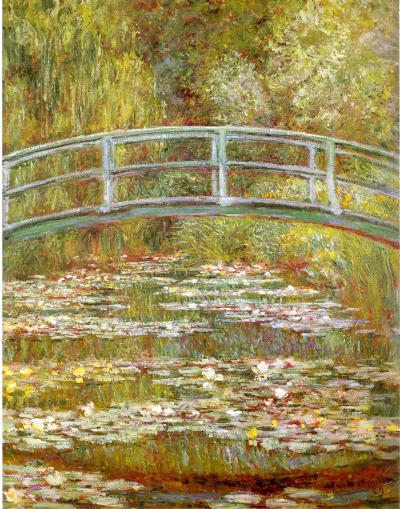
Agapanthus is a
lovely, stalky, showy water flower that appears nowhere in the painting that
bears its name. It is very easy to say that more is suggested than appears on
these canvases, but I get ahead of myself.
This last Friday, I was one of the many who took advantage
of the museum’s Free Friday Exhibitions to see The Water Lilies by Claude
Monet. I did pay to rent the audio tour, partly out of curiosity and partly to
help block out the sounds of my fellow exhibit-goers. In both of these, I was
amply justified. Again, getting ahead of myself.
We ticket holders gathered in a gallery across the Sculpture
Hall from the exhibit. I got a post-it note on the back of my driver’s license
with the numeral 1 on it to hand over for my iPod. The gallery we waited in is
one of the European Art galleries, devoted to the Grand Tour expressed
primarily through landscapes.
Landscapes are the kind of work that I have to look at
closely before I have the sense that I’ve seen anything, and that is difficult
because I generally don’t like them. Judith cutting off Holofernes' head? I’m
there. Saint Francis staring at a skull a la Hamlet? I want it on a magnet. The
view of Tivoli?
Sure? I guess? I blame the television.
I read a whole book on how nature has been represented and thought
of by humans in terms of patriotism, nationalism, character, morality, etc. There
are oodles of plates of landscapes, and I looked at them and I understood what
Schama was saying about them and nothing felt forced. And yet, well, I don’t
get it, but there it is. Throw a knife in the hand of a woman shaming her
husband into committing suicide by demonstrating for him and I will find
everything to say about the furrowed brows, the great swath of color in her
robes, the deep darkness of the backgrounds, etc. But a wander through
threatening boulders? Meh. Barely an adjective. It occurs to me that going to
see the Monet may have been an odd decision in light (ha!) of that preference.
The group was asked to start to line up 5 minutes before our
ticket times. We immediately formed a perfectly straight queue in the middle of
the room, providing slalom for the talkative and very knowing man in the
wheelchair whose wife(?) must have been forever in the wrong if his constant
statements of correctness and criticism were any indication of his behavior in
private. Viewing the painting of St. Peter’s brought him to state that the
gallery is too small and that the paintings should be high, up high, not at eye
level. (I will here say that the glaring of the track lights off the works does
make close inspection a bit awkward) At our appointed time, we crossed the
entry way (Sculpture Hall) and got our iPod thingies and walked into the quiet
of black and white photographs, water gardens and the museum curator comforting
the art-hopeless through the work of seeing art.
I’ve never owned an iPod. This was my first chance even to
use one. I think I could get the hang of it, as long as I have an idea of where
the volume control is. And that is my only complaint about the audio
experience: there were times when it was too loud. No ear buds, instead the
headphones were fitted with soft and cushy pads. There was no loud clicking of
play buttons or metallic sliding of cassettes or clunky anything. It’s a
brilliant development in self-guided tours. Truth.
As you walk into the exhibit, you are greeted with a large
photograph of Monet and another large photograph of the water garden. There is
a bit of verbage about the dates of the work (1915-1926) and an introduction on
the iPod. The next gallery is dark and quiet with a soft bench and a projected
video of Monet painting in the garden at Giverny. I watched the video and
welcomed the peaceful musical interlude provided there. The video is about 2
minutes long and is on a continuous loop, and the music is excerpts from pieces
inspired by Monet’s work.
The next gallery held verbage about the garden, a very quick
biographical sketch of M. Monet and a black & white photograph of the
triptych taken in 1921.
The next three tracks on the iPod discussed the three
studies on the walls of the next gallery: two of water lilies and one of Agapanthus. The colors, brush strokes
and suggested shapes rather than finished representations are well worth the
time to stand still for a minute, off to the side, and just look at the work
the painter is doing in them. The curator of Modern and Contemporary art at the museum, Simon Kelly, gives what I found to be helpful information and a way
into the pieces. He offers general observations about color scheme and focuses
your attention on one or two details in each piece that act as an anchor for
viewing.
The Triptych is along the far wall, opposite the door you
walk through. I cried. It is nothing to say that though, because I will cry at
any movie where there are moving pictures and music playing. What I mean is
that something shifted when I saw the wall of shifting colors and barely
perceptible definition. In a garden, everything moves with wind or changes in
changing sunlight. A painting, especially one in a room with consistently
controlled lighting, does not ever change, except in the viewers’ perceptions.
As such, if the artist wants to invoke the feeling of a water garden, the
viewers’ attentions must constantly be drawn from one part of the painting to
another, following lines that here are like ripples but a foot across. My eyes
were not still the whole time I looked at the work.
There is a Diptych on the opposite wall, on the wall with
the door. It is far less smooth, even than the others, and I found it difficult
to enjoy fully. I did not want to look away from it either. According to track
06 on the iPod, Monet was legally blind in one eye and had 10% vision in the
other when he did this work, which is of the reflection of wisteria swagged from
the Japanese bridge over the water garden.
The exhibit ends just outside the gift shop where I traded
the iPod for my Driver’s License and filled out the very quick Exhibit Survey.
The gift shop, as most art museum gift shops, is a joy and while I do not know
if I’m as keen on decorating my home in one city (St. Louis) with the looks and
attractions of another city (Paris), the refrigerator magnets and playing cards
and also the Handbook to the St. Louis Art Museum Collection and a few of the
puzzles (double-sided, no less) appeal to the sense of responsible decorator in
me.
I plan to go again. I would really like to do more reading
on the criticism of the paintings, on the techniques that are used to preserve
and study them, of the garden at Giverny and perhaps even some more
biographical information about Monet himself. I hope that many people go and
see this exhibit, it is not a strain on the senses, and offers a carefully
created pleasant shift from the stress of day to day life and the sights of the
city.
(altho, you gotta know, if it doesn't look like Wil Wheaton's then its power is effectively reduced by 800%)
There's more out there!
So don't allow the unconnected nature of the most recent spate of library catalogs hem you in: walk stacks, stare at artwork, get interested in stuff, defy incompetence with imagination!
Thursday was a day for sitting very very still and reading a
little bit after my impulsive walking binge. The kind of day that found me face
down in a new book I’d heard about from the tour guide on Wednesday. It’s
called St. Louis Architecture: Three Centuries of Classic Design and was
published (in Australia,
natch) in 2010 as one in the American City series. There has been and continues to be a certain amount of tearing
down and building up and changing use of streets and neighborhoods, it is a
part of the life of every city and every life form. (Understanding, of course
that in the case of something like a guinea pig: the streets and neighborhoods
are allegorical in and not meant to suggest any literal reading of the anatomy
of such a critter.)
I’ve also got a book about St. Louis that came out in 2000,
I think, and while it is a much more broadly based study of buildings and
churches, its focus is not the architecture as it relates to the study of that
field. There is an enormous amount about the history of places in the city that
is learned by looking at the buildings that stand there. I’ve had difficulty
getting into the book because it moves around a bit and the maps, while clear
and showing the locations of the buildings and districts very specifically, use
a numbering system that acts more as a barrier to understanding.
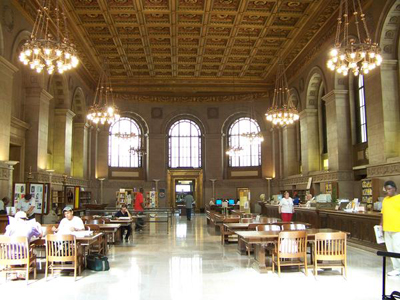
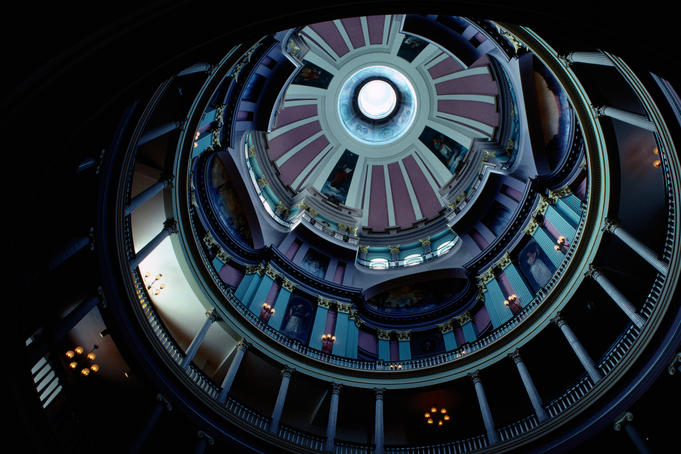
I have now seen pictures of the inside of the Central Library. They inspire me even more to want to wander in the relatively
unpeopled stacks and lie on the floor of the delivery room to stare up at the
ceiling: a thing I also want to do in City Hall, the Old Post Office and Union Station.
That wouldn’t be a bad way to plan a tour of the city,
really – ceilings that you want to gaze at from a horizontal position. I can
imagine scores of nattily dressed tourists sporting skorts and yoga mats
covering the floor of the Old Courthouse, cameras flat on the ground, pointed
up. Conversations about how to get into the Wainwright tomb to take a peek at
its rarely photographed (tho incredibly gorgeous) ceiling, or the Shaw Botanical Garden Library and Museum flittering over Important Information from the tour
guide. I think I want to be that tour guide. You’d have to be trustworthy and
inspire a sense of fearlessness in your temporary flock. Hm. I wonder if I can
find an app for that…
Today there was rest, for tomorrow there is much to explore
and to see and ponder.
Oh, but new favorite thing: Cats landing on the smooth table
surface with all the grace of an albatross not in flight. Ethel slid on her
haunches (surprised as all get out), knocked a book off the table, knocked
several breakable things (which did not break) into each other and then
careened right into her brother sitting on the windowsill. Within nanoseconds
they were both on the other side of the apartment.
Ever fancy a good wander? I’m all in favor of good wanders,
although I am not in favor of wandering too much without some preparation. Forest Park provides more
than 1300 acres for wandering, and that is precisely what I did today: directed
wandering.
The park was established in 1876 and was the site of the
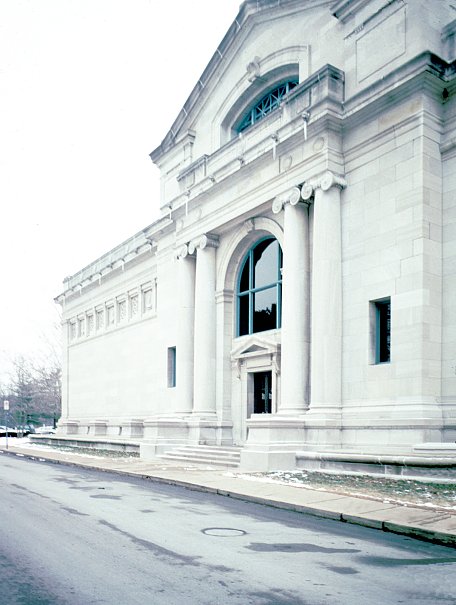
Louisiana Purchase Exposition: 1904 World’s Fair. The façade of the St. LouisArt Museum,
the GrandBasin and some third thing (didn’t catch
quite what, don’t want to misinform) are the only remaining physical features
from the fair.
There is a statue of Saint Louis (now identified as Louis IX)(which is good because I was getting a bit confused – have you heard about
Louis XIV or Louis XVI?!? I mean, really.) that crowns Art Hill which slopes
down from the St. LouisArt Museum to the edge of the Great Basin. That statue is a permanent replica of a temporary statue
that was in front of the building where the Missouri History Museum now stands. I love
this. With funds from the fair, the statue was cast in bronze, a pavilion was
built (named the World’s Fair Pavilion (no temporal relation)) and a pagoda was
given as gift to the city of St. Louis.
The park has undergone extensive renovation and maintenance
in the last 20 years. A group called Forest Park Forever, privately funded,
formed in 1986 with the aim of restoring the park to the people of the city: to
clean it up, make it safe, develop recreational opportunities and generally
provide for its well-being as an integral part of the urban life of St.
Louisans. People have responded. The park was scattered with all sorts of
people this morning – 10am
on a Wednesday during school season.
Picnic Island is one of the
places where such response is visible and will continue to be so for the next
several decades (assuming that zombies are not adverse to open green spaces
after the apocalypse, of course). It is right now no kind of place to have a
picnic between the hours of dawn and dusk. There are no tables in sight and the
trees are either so tall that the shade their leaves cast is dissipated halfway
down the trunk, or so young that you could sneeze near them and they’d fall
over. But there are young trees, and that is the salient point: donors are
donating, they are paying for trees to be bought, planted and cared for so that
in five to ten years the Island will start resembling a place where picnicking
can happen.
I’ve learned that there are bird walks on the first Saturday
of each month – I’m thinking of going to the one in December. There’s a
volunteer opportunity in the form of ripping up honeysuckle (exotic and
invasive) the first Saturday in November which sounds like heaps of fun, so I’m
adding that to the plan of events. There is a boat house where paddleboats and
rowboats and bicycles are available for rent. The bicycles, presumably, do not
afford passage on the water, but they may have fins, I don’t know. There are
three restaurants in the Park, and I’ve been going over the list of people who
are coming to visit me, or who will come to visit me once I can compile a
tempting enough itinerary of sightseeing, events and eats, and those
restaurants may have to be included in the pool of things I draw from.
I am, naturally, completely exhausted. It was not enough for
me to take the morning wander, no. I had to wander across a hill to spend over
an hour wandering around the art museum, too. Got my ticket for Friday. Decided
to go with the audio tour for this first visit – it may be very busy, I do not
wish to be distracted with rage.