Showing posts with label The Water Lilies. Show all posts

Monday, 17 October 2011

Perspective on Monet


Attempting to read up on Agapanthus becomes an increasingly interesting adventure. I learn not much that is terribly surprising, but I am a bit stymied in my limited resources. Right now I have access to one book in front of me and a few that I’ve requested at the library. It is in that light that I must turn back to what is in front of me: the paintings and a handful of books and articles, and mine them instead of the shelves of possibilities that I know exist.

As a relative amateur when it comes to art criticism, and a virtual expert on talking about whatever comes to mind, this series of blogs has become something of a quest with me. There is only so much that can be seen when looking at 3 paintings, no matter how large. There is infinitely more that can be said about them, or learned about them, or discovered underneath them. But without ever seeing them, without ever looking at what is in front of your nose, none of the rest of it is more than mere decoration.
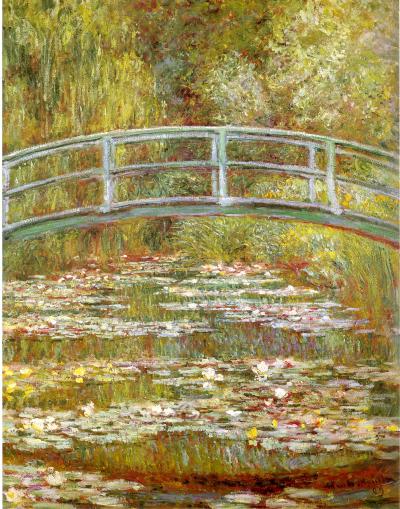
Simon Kelly, in the wording that accompanies exhibit, talks about the effect that the lack of horizon line has on the painting itself and on the viewer. It is true – these are works that exist almost entirely outside of the standard geography of living. There is no bridge, there are no reflections; you do not know what time of day it is; who is around, if anyone or if there are any deeper meanings to the shapes and shifting swaths of color in front of you. I hate to be too pithy, but all of this almost forces the viewer to be reflected in the paint: we see ourselves in the surface. At yet, the experience is not disorienting. It is stunning, or at least it can be, but not upsetting, not to us who are so accustomed to such vast expanses of undefined space.

In Monet at Normandy, the publication that accompanied an exhibit by that name in 2006 & 2007, it is possible to follow Monet’s use of perspective and point of view from the 1860’s through to the Cleveland panel of Agapanthus, and it is a remarkable development. Discussing the painting A Seascape, Shipping by Moonlight from 1866, the authors address his use of space. “Monet plays with the viewer’s sense of equilibrium by omitting the jetty itself from the field of vision; only the stabilizing line of the horizon as it intersects with the strictly vertical rigging of the boats on the left counters the rolling pitch of the boat in the foreground.(56)” He is not creating here a sense of floating in the absence of the horizon, he is deliberating unsettling his viewers with very little that is stable and much that rolls and is unstill.

In other places, the experiments with perspective seem to be excuses to provide space for the sea or an expanse of beach or sky instead. As can be seen in his paintings of commercial ships in the port at Le Havre or on the Seine at Rouen, he is not shy of detail or specificity. In fact there is the sense that he is communicating something extremely specific, even in the Wisteria diptych that is still incomprehensible to me. (I have to admit here that I’m falling hopelessly in love with his paintings of the Seine at Rouen – the ships are functional and ethereal at the same time, and the skies are filled with a sense of wind and rain and diffused or too bright sunshine. Exquisite!)

“While the viewer instinctively constructs spatial relationships based on scale, position, and color, the artists himself seems no longer bound by such conventions.(168)” And we do, don’t we? Without thinking about it, we decide that there is a top and a bottom that are usually related to the top and bottom of the canvas. We plot the position of shapes and colors not just on the canvas but in relation to each other in the three dimensional space behind the canvas or in front of the canvas. We address ourselves in relation to the paintings: where am I standing in this painting?

I wonder how many of us place ourselves where we have so often seen M. Monet placed: in the garden, under an umbrella, palate on arm, cigarette smoldering. Or in his studio with the gigantic canvases leaning against the walls, as much a part of that space as any other. Perhaps more so. With so many visitors and so much attention given to the work and the garden while he was still alive, it seems plausible that there is as much of the life of the artist’s studio in the layered and floating studies of water lilies and absent agapanthus in these paintings as any representation of nature’s variability.

As much of an intellectual exercise as these can be, there is something excitingly simple and human that can be experienced viewing the triptych. They were part of a larger work that was intended to honor the end of World War I and the veterans. In that light, the serenity of this series has more weight than any horizon line could ever hope convey.


I’ve been looking for pieces of contemporary criticism to give context outside of the artist and outside of the 20th century. Of course, the source that I’d love to read is in the St. Louis Public Library catalog. And equally of course, it is a reference book (non-circulating) of the Central Library (which collection has been moved entirely to a storage facility while the building is closed for renovation until summer of next year). So, how does one get a look at such a thing? The adventure continues.

Lemonades, Heather, Lynn Federle Orr, David Steel. Monet in Normandy, Rizzoli, New York, 2006. 192 pp.

Monday, 10 October 2011

Quest for the Lilies pt 2.


Agapanthus is a lovely, stalky, showy water flower that appears nowhere in the painting that bears its name. It is very easy to say that more is suggested than appears on these canvases, but I get ahead of myself.

This last Friday, I was one of the many who took advantage of the museum’s Free Friday Exhibitions to see The Water Lilies by Claude Monet. I did pay to rent the audio tour, partly out of curiosity and partly to help block out the sounds of my fellow exhibit-goers. In both of these, I was amply justified. Again, getting ahead of myself.

We ticket holders gathered in a gallery across the Sculpture Hall from the exhibit. I got a post-it note on the back of my driver’s license with the numeral 1 on it to hand over for my iPod. The gallery we waited in is one of the European Art galleries, devoted to the Grand Tour expressed primarily through landscapes.

Landscapes are the kind of work that I have to look at closely before I have the sense that I’ve seen anything, and that is difficult because I generally don’t like them. Judith cutting off Holofernes' head? I’m there. Saint Francis staring at a skull a la Hamlet? I want it on a magnet. The view of Tivoli? Sure? I guess? I blame the television.

I read a whole book on how nature has been represented and thought of by humans in terms of patriotism, nationalism, character, morality, etc. There are oodles of plates of landscapes, and I looked at them and I understood what Schama was saying about them and nothing felt forced. And yet, well, I don’t get it, but there it is. Throw a knife in the hand of a woman shaming her husband into committing suicide by demonstrating for him and I will find everything to say about the furrowed brows, the great swath of color in her robes, the deep darkness of the backgrounds, etc. But a wander through threatening boulders? Meh. Barely an adjective. It occurs to me that going to see the Monet may have been an odd decision in light (ha!) of that preference.

The group was asked to start to line up 5 minutes before our ticket times. We immediately formed a perfectly straight queue in the middle of the room, providing slalom for the talkative and very knowing man in the wheelchair whose wife(?) must have been forever in the wrong if his constant statements of correctness and criticism were any indication of his behavior in private. Viewing the painting of St. Peter’s brought him to state that the gallery is too small and that the paintings should be high, up high, not at eye level. (I will here say that the glaring of the track lights off the works does make close inspection a bit awkward) At our appointed time, we crossed the entry way (Sculpture Hall) and got our iPod thingies and walked into the quiet of black and white photographs, water gardens and the museum curator comforting the art-hopeless through the work of seeing art.

I’ve never owned an iPod. This was my first chance even to use one. I think I could get the hang of it, as long as I have an idea of where the volume control is. And that is my only complaint about the audio experience: there were times when it was too loud. No ear buds, instead the headphones were fitted with soft and cushy pads. There was no loud clicking of play buttons or metallic sliding of cassettes or clunky anything. It’s a brilliant development in self-guided tours. Truth.

As you walk into the exhibit, you are greeted with a large photograph of Monet and another large photograph of the water garden. There is a bit of verbage about the dates of the work (1915-1926) and an introduction on the iPod. The next gallery is dark and quiet with a soft bench and a projected video of Monet painting in the garden at Giverny. I watched the video and welcomed the peaceful musical interlude provided there. The video is about 2 minutes long and is on a continuous loop, and the music is excerpts from pieces inspired by Monet’s work.

The next gallery held verbage about the garden, a very quick biographical sketch of M. Monet and a black & white photograph of the triptych taken in 1921.

The next three tracks on the iPod discussed the three studies on the walls of the next gallery: two of water lilies and one of Agapanthus. The colors, brush strokes and suggested shapes rather than finished representations are well worth the time to stand still for a minute, off to the side, and just look at the work the painter is doing in them. The curator of Modern and Contemporary art at the museum, Simon Kelly, gives what I found to be helpful information and a way into the pieces. He offers general observations about color scheme and focuses your attention on one or two details in each piece that act as an anchor for viewing.

The Triptych is along the far wall, opposite the door you walk through. I cried. It is nothing to say that though, because I will cry at any movie where there are moving pictures and music playing. What I mean is that something shifted when I saw the wall of shifting colors and barely perceptible definition. In a garden, everything moves with wind or changes in changing sunlight. A painting, especially one in a room with consistently controlled lighting, does not ever change, except in the viewers’ perceptions. As such, if the artist wants to invoke the feeling of a water garden, the viewers’ attentions must constantly be drawn from one part of the painting to another, following lines that here are like ripples but a foot across. My eyes were not still the whole time I looked at the work.

There is a Diptych on the opposite wall, on the wall with the door. It is far less smooth, even than the others, and I found it difficult to enjoy fully. I did not want to look away from it either. According to track 06 on the iPod, Monet was legally blind in one eye and had 10% vision in the other when he did this work, which is of the reflection of wisteria swagged from the Japanese bridge over the water garden.

The exhibit ends just outside the gift shop where I traded the iPod for my Driver’s License and filled out the very quick Exhibit Survey. The gift shop, as most art museum gift shops, is a joy and while I do not know if I’m as keen on decorating my home in one city (St. Louis) with the looks and attractions of another city (Paris), the refrigerator magnets and playing cards and also the Handbook to the St. Louis Art Museum Collection and a few of the puzzles (double-sided, no less) appeal to the sense of responsible decorator in me.

I plan to go again. I would really like to do more reading on the criticism of the paintings, on the techniques that are used to preserve and study them, of the garden at Giverny and perhaps even some more biographical information about Monet himself. I hope that many people go and see this exhibit, it is not a strain on the senses, and offers a carefully created pleasant shift from the stress of day to day life and the sights of the city.