Showing posts with label Antonio Panizzi. Show all posts

Tuesday, 18 October 2011

To Honor the Catalogers. Sort of.


 The last part of a passage I previously quoted reads thus: “It’s tempting to say that his [Panizzi’s] discovery of intertextuality among even the most mundane books forebodes the rise of the interconnected world of the digital age; it’s probably more accurate, however, to note that, from the vantage point of the wire world, Panizzi’s catalog looks like the beginnings of the Internet.”¹

I immediately thought of Douglas Adams whose piece called “Build It and We Will Come” was published in The Independent on Sunday in November of 1999. The writing is included in a posthumously published collection of Adams’s writings called, delightfully, The Salmon of Doubt². It is also available as an audio book, which is how I first experienced it, and makes for wonderful and enlightening moments. The breadth of the man’s interests and writings astonished me and was also incredibly freeing, as was the recognition of the difficulties of writing to deadline.

Why this piece in particular? Because of the thesis statement buried deep in the middle of the thing: “The computer is actually a modelling device. (92)”²

Because the person who wrote it is Douglas Adams, and because I agree with him firmly based on the evidence given in the aforementioned essay as well as independent ponderings after the fact, I’m not going to try to convince you of the truth of the matter. I’m going to treat it as fact.

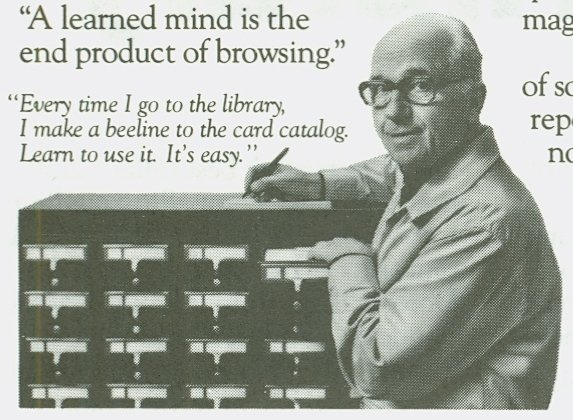
Thinking of the catalog of Panizzi as the monster of bibliographical information that it must be (with equally contorted card catalogs that threatened to, and eventually did take over many library lobbies and reading areas, and the sort of relief the floors may have felt when computers with much smaller footprints began to carry the same information): what exactly is a catalog modelling? I believe it is the brains of The Library. I would say that the catalog is modelling the actions of Librarians, but they are (in Truth if not in practice) specialized beings whereas catalogs are created for the generalist user/reader/patron. Online catalogs are incredibly useful entities for organizing, tracking and adding to or removing information from entries into the catalog. They have the potential to interact with other, already established catalogs, create MARC records with little strain and also can be programmed to make bar codes and spine labels.

They can do everything that a team of librarians can do, and they can do it more quickly and with less overt physical effort on the part of those librarians. They do not replace human ingenuity or interaction with materials, and they do have to be made to be flexible. But the basic idea of an online or digitally maintained catalog is that when a person, a human, looks for a book, that person goes to a provided computer terminal or available website, enters the information that is at hand, and is given the coordinates to find that item within their current context. Lists of books that don’t get checked out, lists of periodical titles that the library holds subscriptions for, items that are on order, damaged, in transit, etc. are generated as part of the library’s functioning.

I know a woman who works at A Novel Idea in Lincoln, Nebraska whose co-workers describe her biblio-recall abilities as watching her flip through her mental Rolo-Dex. I’m sure that the information that she stores on those cards appears in different places as the keywords or characters or impressions or genres are the unique search terms in different situations. It takes time to build the kind of depth and specificity into such a mental search engine as she has, but I have felt it begin and have encouraged it to take root on my own, and while mine is more of a commonplace book or recreation room strung with yarn and connecting images, and will never rival the power of what an online catalog can accomplish, still, it is confirmation that our brains can and do surpass our wildest expectations of them.

The library catalog has the potential to accomplish something no less daunting than magic. It can help a reader find something he or she was sure they’d never be able to identify. It cannot always leave traces of how to find the treasure someone seeks, but it can, through subject headings, authors, titles, series titles, keywords and the like, show the reader something like the path that was taken to get to the treasure the first time.

In order to accomplish such formidable tasks, minute and thorough items of information have to be identified and entered into the knowledge base of the catalog. It must be told when and how an item came to be in the library. It must be told how an item relates to another item. Humans must make educated guesses about the use of an item and include what information will allow that item to be used and useful. Other humans may be given the opportunity to add reviews and search terms, to suggest connections that the catalogers may not have known existed. Involving the patrons in the development of the library catalog is one of the brilliant strokes of catalog development. It has need for mediation, but it is a powerful way to engage library patrons with library materials.

The catalog is a model of the relationships built between libraries and their communities. It is in deciphering those relationships that we learn about the design of the model, and what meaning the library is seen to have in the community.


¹ Battles, Matthew. Library: An Unquiet History. W.W. Norton & Company, New York, 2003. 214 pages +notes & index.

²Adams, Douglas. The Salmon of Doubt, Harmony Books, New York, 2002. Paul Guzzardi, ed. 299 pp.

³MentrĂ©, Mireille. Illuminated Manuscripts of Medieval Spain, Thames and Hudson, Inc, London, 1996. Jenifer Wakelyn, trans. 304 pp.


 Before I end this, I have to put my nomination forward for canonizing Douglas Adams (who was, I know, an atheist; have a sense of humor). I thought of that particular essay as I was typing up the other post. At the library, I went looking for Homer in order to get details and ideas in mind for what I plan to write during November (NaNoWriMo!), and found The Salmon of Doubt instead. When I’d gotten home, fed the (starving!!!) cats, and unloaded my library haul (Illuminated Manuscripts of Medieval Spain³, anyone? Oh, yeah), I opened the book right to the essay I wanted, even to the page and almost the line. You can’t respect the man without at least nodding at his beliefs, so I can’t quite see naming him a Deity, but at least a halo of connectivity on portraits? If someone gets a chance, ask Stephen Fry, will you? He’d know what to do.

Wednesday, 12 October 2011

In honor of the Catalog

The Library Catalog: that labyrinth of titles, authors, subjects, keywords, publication information, series titles and perhaps even major characters that is the map to infinite intellectual treasures. Well, it is now. When I was younger it was a torment invented by cranky old men and women who wanted nothing more than an empty room and silent students giving correct answers. Ah, the gentle nature of youth!

I am still working through Matthew Battles’s book Library: An Unquiet History, and thoroughly enjoying myself. Today, I read about Antonio Panizzi, the man who redesigned the library catalog of the British Museum and in so doing, changed the way patrons and librarians interacted with that catalog permanently. He was a young attorney who found himself in exile from his home state of Modena in Italy in 1823 after publishing an account of the trials of revolutionaries with whom he’d associated. He escaped over the Alps, was sentenced to death in absentia and eventually found himself in England where he tutored in Italian, learned English and eventually got himself appointed assistant librarian at the British Museum in 1831 (128-9).

His work “cataloging a collection of impossible complicated tracts from the English Civil War (129)” marked him as the best person to take on recreating the catalog from 1810, which in seven volumes with pages and pages of notes and addenda was becoming unusable. That catalog had been written as an inventory, in alphabetical order by book title, and Panizzi found that in many cases information was incomplete and there was no connection drawn between any of the works.

“Such crucial information as the author’s name, the publisher, and the date and place of publication might be incomplete, erroneous, or missing altogether. Panizzi developed a series of rules that reproduced these relations in the catalog, so that librarians – and crucially, readers – could trace and follow them. Unwittingly at first, he was helping to transform the library catalog from an inventory into an instrument of discovery. (130)” (emphasis mine)

In 1837 he was appointed Keeper of the Books and in seven years published one volume: A. The amount of time that it took Panizzi to create the catalog inspired a certain amount of grumbling on the part of some people, namely one Sir Nicholas Harris Nicolas. Battles explains that part of his invective was to do with jealousy that Panizzi had so much influence in the library, partly there is a concern: “he is afraid that it (the complexity of the catalog) will make the reader do more work. (131)” While that reads alright, as Battles goes on, we begin to see there is something far more familiar than empathy at work.

“Early in the project, Panizzi had chosen to add the ‘pressmark’ of each book to its entry in the catalog. Like a call number on a modern library book, the gnomic pressmark indicated precisely the place where the book was to be found among the shelves of the library stacks (or ‘presses,’ as bookshelves were commonly called). (132)” The idea is that the pressmark indicates a geographic location; it does not refer to a subject or topic as Dewey call numbers do. If Dewey number 720.977 will find you in front of a book on Architecture in St. Louis, the number 230 c 9 in Panizzi’s catalog will find you looking at a book in the press (shelves) numbered 230, shelf c, position 6 (I’m thinking from the left, but that is a culturally grounded assumption).

Nicolas took offense at the amount of work a reader had to do to learn and understand all 91 rules Panizzi developed for his catalog. However, “Nicolas sensed that Panizzi was trying to produce not only a new kind of catalog but a new kind of reader as well – one more independent, more knowledgeable of library systems – and he wished to play no part in the revolution. (132-3)”

In Panizzi’s view of his catalog it was something that ‘”the public have the right to expect in such an institution”…”I want the poor student to have the same means of indulging his learned curiosity,”…”of following his rational pursuits, of consulting the same authorities, of fathoming the most intricate inquiry as the richest man in the kingdom.”(130-1)’ His work was not intended to play the part of something like a shopping list, it was meant to draw readers into the world of discovery, and to provide equal opportunity for every reader to be drawn in, not only the rich and not only the poor. His rules built bridges of connection.

I’ve never seen this catalog. I would love to. I expect that it would look fairly incomprehensible at first. Then again, I felt that way about Dewey and also about Reader’s Guides and most bibliographies.

Libraries now seem to be catering to the reader like Nicolas, who does not want to think too much about deeper questions than “is this title available and for how long can I have it?” I begin now to see catalogs grounded in the philosophy that it is not necessary for readers or librarians to draw from a diversified and intellectually stimulating range of texts and materials, rather that staying with the range of a single title will do just fine.

It is a revolutionary idea anymore that challenged and challenging inquiry is the mark of a well-grounded and developed adult. There is subversion in seeking out more than one answer to the same question. There is even more subversion in finding more than one question to go with each answer. Libraries do not have to be veiled hiding places of incomprehensible babble. They can be transparent organisms well-traveled and identified. Catalogs, well designed and maintained (not easy work, either of those), can begin to provide libraries with transparency, but they do need to be learned and translated, and that is not comfortable.

Battles, Matthew. Library: An Unquiet History. W.W. Norton & Company, New York, 2003. 214 pages +notes & index.